Flight ClassesEconomy SeatsPremium EconomyBusiness ClassFirst ClassFare Codes
The fare code letter is the real price tag
Look past the dollar amount — the one-letter booking code on your ticket is what airlines use to control what you paid and what you can change. On American, 'F' means full-fare first class, 'J' is full-fare business, and 'B' marks basic economy. United uses 'J' for first/business and 'Y' for full-fare economy. Each seat is assigned to a fare bucket, and airlines set bucket inventory by algorithm using route, time of day, season, and expected passenger mix. When a bucket sells out, it doesn't refill. Travel agents and subscribers to services like Expert Flyer can see how many seats remain in each bucket; regular shoppers can't. The fare basis code, which begins with the class letter and adds letters for season, advance purchase, and min/max stay rules, lets agents pull the exact rules for your ticket. If your itinerary has multiple fare codes, the most restrictive portion governs your changes.
Economy’s basic seat: 16 to 19 inches wide, 29 to 34 inches of pitch
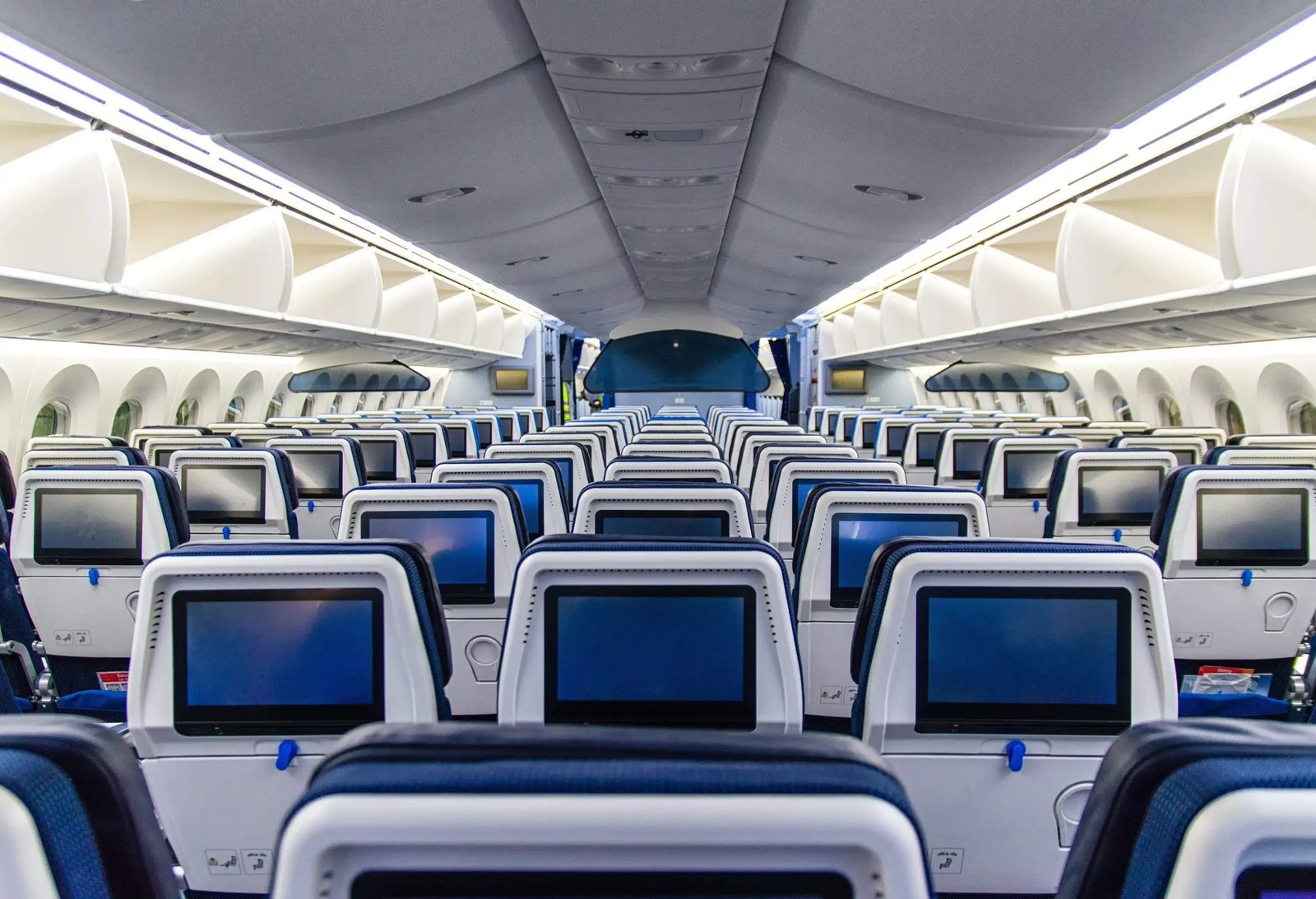
Economy gets called coach, main cabin, or cattle class, and the seat dimensions define it: widths run from 16 inches to just over 19, and seat pitch — the distance from one seat to the one ahead, commonly read as legroom — runs 29 to 34 inches. Some carriers still include freebies: jetBlue and Hawaiian hand out snacks, drinks, and entertainment at no extra charge. Others strip it down: low-cost Allegiant, Frontier, and Spirit sell only coach, with extra space and perks priced as add-ons. Industry observers note that some seats have shrunk over time while others have held steady across all cabins. The width and pitch you get can vary by aircraft type and even by airline configuration, which is why published dimensions matter more than the class name. And in economy, the cheapest fare often costs more in rules than in cash, because change fees and upgrade eligibility are tied to the fare class you buy.
Premium economy: a wider seat, a few extra inches, and a curtain
Virgin Atlantic introduced premium economy in 1992, and dozens of carriers now offer it on domestic and international routes. On long-haul flights it’s often a physically separate cabin; on domestic flights the same name can mean just better seats at the front. Alaska’s Preferred Plus seats are 17 inches wide with 36 to 40 inches of pitch, priority boarding, early deplaning, and free entertainment. American’s Premium Economy runs 17.1 to 19.3 inches wide with 34 to 38 inches of pitch depending on plane type. WestJet’s premium cabin on select aircraft goes up to 25.7 inches wide with 36 to 38 inches of pitch on Boeing 737s and 767s. Frontier’s Premium is 18 inches wide with 33 to 35 inches of pitch, but it doesn’t include entertainment and has no boarding priority. The common denominator: more space, and the extras vary widely enough that reading the specific seat map pays.
Business class got its start after fares climbed, and it keeps evolving
Business class took shape when international first-class fares climbed sharply and full-fare coach travelers wanted something between; Pan Am and Qantas were pioneers. Continental folded business and first-class perks into “BusinessFirst” in the early 90s. Today it ranges from a recliner to a private pod. Delta’s Delta One has a 180-degree lie-flat seat, enhanced privacy dividers, upgraded bedding, and meal service on select international routes. American’s Flagship Business offers lie-flat seating on international flights and flights to Hawaii, with upgraded meals and amenity kits. jetBlue’s Mint is a 6-foot-8 lie-flat seat with adjustable firmness and a massage feature, plus a privacy door and full meal service. Airlines like Alaska, Allegiant, Frontier, Porter, Southwest, and Spirit do not sell a separate business cabin; their highest tier is an upgraded coach seat with extras like an empty middle seat or premium drink.
First class tops out at three rooms
No cabin goes further than first class. Etihad’s The Residence is a three-room suite: a living room, a bedroom with a double bed, and a private bathroom with shower. Within North America, the product is more modest but still distinct. Alaska’s first class gets up to 21 inches of seat width, 41 inches of pitch, pre-order meals, two checked bags, and free alcohol. American’s domestic first class runs 19.5 to 21 inches wide with 36 to 38 inches of pitch, or lie-flat on some aircraft; its Flagship First on international routes adds lounge access and upgraded amenity kits. Delta’s first class has a dedicated flight attendant, upgraded meals, and lounge access, with seats up to 20.9 inches wide and 38 to 39 inches of pitch. Hawaiian’s first class reaches 21 inches and 45 to 46 inches of pitch, or lie-flat depending on aircraft. Allegiant, Frontier, jetBlue, Porter, Southwest, and Spirit don’t offer a first-class cabin.
Same plane, different airline: why seat maps lie
Two airlines can fly the identical Boeing model and still serve up different seat widths and legroom because each carrier configures interiors its own way. Stephen Carbone, who worked at the NTSB and FAA, points out that airlines were once subsidized, so they could fly fewer passengers to more out-of-the-way places with wider seats; the shift to hub-and-spoke routing changed the calculation to “how many seats can we legally and safely fit.” The result is that an economy seat on one carrier may not match the same plane on another. The safe move is to check the seating chart your airline publishes for your specific flight number and aircraft, not a generic chart from a plane-spotting site. If no chart is available, call the airline and ask an agent for the seat dimensions and pitch for that tail number. The differences affect not just comfort but whether your carry-on fits and how quickly you get out.
Miles come from fare class, not distance flown
Your frequent-flyer mileage for a flight is set by the fare class letter, not by the odometer reading of the route. On many airlines, a full-fare ticket in a high booking class earns double or triple miles, while deeply discounted basic economy fares may earn nothing at all. The booking codes determine how many miles you’ll accrue, and each airline publishes a mileage-accrual chart that maps fare letters to earning rates. If your goal is elite status or a future award, you may need to buy a more expensive fare class rather than the cheapest seat. The fare class also controls upgrade and standby priority. On American, for example, F sits above J in the hierarchy, so a full-fare first passenger gets earlier upgrades and standby than a discount business passenger. That hierarchy isn’t just about money — it’s about who moves up when a seat opens.
No business class? These airlines sell “big front seats” instead
Allegiant and Spirit keep it simple: one coach cabin, with premium space sold as add-ons. Allegiant uses a single fare class and offers “Giant Seats” — six per plane, up to 25 inches of seat width — plus a Legroom+ option that increases pitch to 34 inches. Spirit is all-coach but sells a BIG FRONT SEAT that measures 22 inches wide with up to 34 inches of pitch; it doesn’t include entertainment, and shortcut boarding is an extra purchase. Both carriers market these seats as a middle path, giving passengers who want more room a way to get it without buying a fully separate cabin. The trade-off is in the extras: no lounge access, no dedicated flight attendant, no lie-flat bed. It’s a cost-focused way to move up, and it’s worth comparing the total price of a Giant Seat or BIG FRONT SEAT with a main-cabin fare on a legacy carrier before booking.
Delta’s three-tier economy is a lesson in a la carte pricing
Delta splits its coach product into three distinct products, and knowing the difference changes what you pay for flexibility. Basic Economy is the cheapest, but it comes with no eligibility for upgrades, no complimentary changes, and seats randomly assigned only after check-in. Main Cabin eliminates change fees, adds complimentary snacks and drinks, and lets you choose seats after purchase. Delta Comfort+ sits at the top of economy, with free seat selection, extra legroom, dedicated overhead bin space, and early boarding. Delta uses separate fare codes for each tier: “E” for basic economy, “U” and “T” for discounted main cabin, and “Y”, “B”, “M”, “W”, “S” for full-fare main cabin or Comfort+. If you need to change plans, buying Main Cabin instead of Basic Economy may be worth the price difference; on many routes the basic fare saves little once you factor in the lack of flexibility and random seat assignment.
From all-first-class 1914 to a curtain in the 1950s
When the first commercial flight took off in 1914, every seat was first class — there was no other class to sell. Seth Kaplan, managing partner of Airline Weekly, notes that in the 1950s carriers like Delta began experimenting with coach flights at off-peak hours, not as a separate cabin behind a curtain but as entirely separate flights. Later, airlines put two cabins on the same flight, and deregulation pushed them to add more seats per plane to profit per flying mile. Stephen Carbone, who worked at the NTSB and FAA, traces how subsidized routes allowed wider seats and fewer passengers, until the economics of serving more destinations changed the math. The historical shift explains why today’s economy seat can feel thin: the cabin is optimized for density, and premium cabins exist to capture travelers who will pay more for the space that density removed. Knowing that history helps you read seat maps and fare buckets as what they are — a pricing system built around density.