Celiac DiseaseTravel SafetyChronic IllnessMedical ResearchCareer ChangeAdvocacy
Selling the 25,000th Celiac Translation Card
The sale of the 25,000th celiac translation card this year marked a major milestone for travelers with gluten intolerance. Developed after a 2015 trip to Japan revealed gaps in existing tools, these cards now cover 21 languages, with Croatian, Korean, and Khmer added in 2025. Each card lists safe and unsafe foods in the local language, along with translations, allowing users to communicate their dietary needs at restaurants and street stalls. Whitelisted for use by travel agents, physicians, and hospitals, they provide specific food lists that help prevent cross-contamination and ensure safe dining experiences. Despite challenges like unauthorized resale, where some buyers redistribute the cards, the resource continues to empower celiacs worldwide by turning a personal travel pain point into a practical tool for navigating foreign menus confidently.
Publishing New Gluten-Free Travel Guides for Cambodia and South Korea
Two essential gluten-free guides were published this year, targeting Cambodia and South Korea. Each guide, ranging from 3,000 to 5,000 words, details safe and unsafe foods, lists celiac-friendly restaurants and shops, and includes the corresponding translation card in local languages. Part of a series now covering 15 countries, these guides were developed with reader collaboration to ensure accuracy. They build on a decade-old template that prioritizes explaining local cuisine, helping anxious travelers identify gluten-free options at street stalls and eateries. The guides are freely available online, allowing travelers to download them before their trips. In practice, users cross-reference the food lists with menus to avoid gluten, and the translation cards aid in clear communication with vendors. This approach ensures that celiacs can explore local food scenes without compromising their health.
Leading as Board President of the Spinal CSF Leak Foundation
Voted in as Board President of the Spinal CSF Leak Foundation, a 501(c)(3) nonprofit, she managed a hiring process for a new executive director, receiving over 130 applications. Her role involved coordinating interviews, creating scoring systems, and consulting pro bono employment counsel. Additionally, she oversaw planning for the annual conference, launching the first international patient registry, and organizing the awareness week known as leakweek. This leadership position required integrating legal, business, and advocacy skills to advance research and support for patients with this debilitating condition. The hiring process involved crafting interview questions, evaluating candidates with board members, and navigating legal aspects with employment counsel. In her daily work, she balanced these organizational tasks with personal health constraints, dedicating a significant portion of her limited upright time to Foundation duties.
Co-Authoring a Research Paper on Dynamic Myelography Reporting
A myelogram is a diagnostic imaging test for spinal CSF leak, involving contrast dye injected inside the dura to generate detailed output that helps locate a leak or dural defect. Dynamic CT myelography builds on this by changing patient positioning and scanning in real-time, allowing physicians to visualize contrast escaping from the dura and locate certain types of leaks invisible without the dynamic component. As a patient author in her first medical research paper, she collaborated with a group of physicians to develop SIH-RADS, a standardized reporting system for dynamic myelography. The system was evaluated through surveys of both patients and referring providers. Findings showed that SIH-RADS improved clarity in reporting spontaneous intracranial hypotension and that physicians preferred it to traditional reporting options. The journal published a summary of the findings for broader access. For patients, a standardized system means imaging reports become more interpretable across institutions, reducing confusion as cases move between specialists. The full paper is titled "Enhancing Clarity in Dynamic Myelography Reporting: Results of a Survey of Patients and Referring Providers Evaluating a Standardized Reporting System in the Myelographic Work-Up of Patients with Suspected Spontaneous Intracranial Hypotension."
Speaking on Barriers to Care at a Medical Conference
She felt nervous before the talk, aware of the pressure of representing the spinal CSF leak community while communicating in a way that would make physicians willing to listen. Structured as a fireside chat, the session paired her with Dr. Andrew Callen, a neuroradiologist from the University of Colorado, for an open conversation. They tackled topics from both patient and physician perspectives, discussing aspects that are difficult for each side — diagnostic delays, the gap between clinical understanding and lived experience, and barriers to receiving appropriate care. She delivered her remarks standing up. As the only patient speaker at the conference, her session drew positive feedback from attendees. The conference also featured patient moderators who guided questions after physician-only talks, ensuring patient voices shaped the broader dialogue throughout the event. For patients and families navigating spinal CSF leak, sessions like this one demonstrate the value of direct patient-physician exchange in identifying gaps in care and pushing for systemic change.
Curating the Curious About Everything Newsletter Monthly
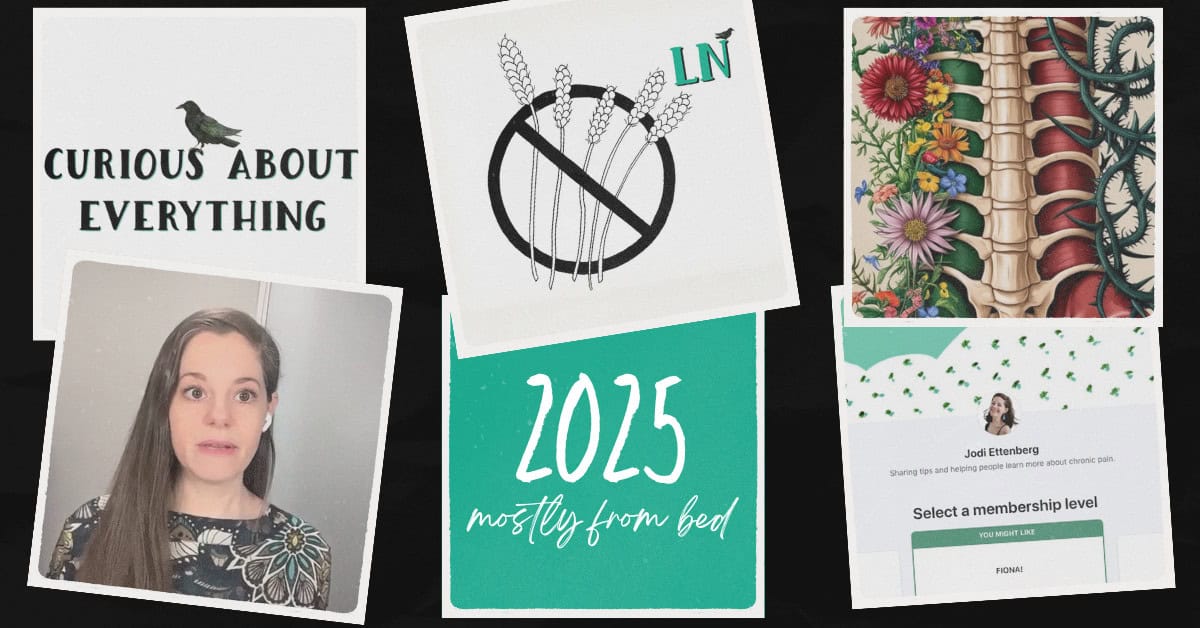
Curious About Everything began as "Linkies of the Day," a compilation of links she read during her years as a lawyer, then became "Links I Loved" after readers asked her to compile pieces she shared on Twitter. After sustaining her spinal CSF leak, she redesigned Legal Nomads and reimagined the newsletter as CAE, embodying the curiosity that kept her going through years of chronic illness. Issue number one went out on November 15, 2020. By December 2025, she published CAE 57. Each monthly issue includes a "start here" section highlighting what she found most compelling, a "best of everything else" roundup, a bullet-pointed "quick links" list of shorter pieces, and a spotlight on one artist whose work caught her attention. She keeps the newsletter free so long as her Patreon and celiac card sales sustain her business. Compiling each issue from bed requires hours of reading and selection across a wide range of subjects — science, culture, human interest, and more — all filtered through the lens of a mind that has never stopped seeking.
Writing Niche Content on Patreon With Specific Topics
Her Patreon serves as a home for writing that fits neatly into no other category. Topics in 2025 included thundersnow — what it is and why it happens — along with a crash course on the Canadian electoral system, a piece exploring whether inflammation can cause depression in people with insomnia, a post explaining why she has not pursued further treatment for her spinal CSF leak, and an animal profile on anteaters, part of a series that previously featured shoebills. The anteaters post is public and accessible without membership. Rather than offering tiered deliverables, she built a "Support Only" structure where every member gets the same access regardless of pledge amount. The three tiers are named after birds: Bob the bluebird, Fiona the robin, and Arthur the raven, who also serves as the mascot of Legal Nomads and Curious About Everything. Each month, members receive overflow links that did not fit into CAE, short life updates, and photos. She is not eligible for disability in Canada, so the consistent income allows her to dedicate significant time to volunteer work with the Spinal CSF Leak Foundation. The first person to suggest she launch a Patreon was a reader named Justin, whose nudge she credits with starting the membership. For annual signups, a 15% discount was offered through January 5th using the code 2025YEAREND.
Updating Key Blog Posts With New Data and Retrospectives
Several key blog posts received substantial updates in 2025. The Vipassana meditation piece from New Zealand, a ten-day silent course she credits with changing her life, now includes a section looking back on the retreat a full decade later. Her jet lag tips post was revised with new sleep studies and updated app recommendations. The mast cell activation syndrome page expanded to roughly 20,000 words, written in 20-minute increments due to her health constraints. It incorporates new dietary strategies and research linking MCAS to thyroid conditions, long COVID, and the insomnia and anxiety she once thought were standalone problems — both turned out to be byproducts of a dysfunctional immune system, worsened by dengue fever contracted in Vietnam and then pushed further by her spinal CSF leak. The gluten-free guide to Ottawa grew with newly tested restaurants from her 2025 meals around the city she now calls home. Her resources page for lawyers considering career changes was refreshed based on new reader feedback, though the guidance applies to any career pivot. She also published a new piece dismantling the myth that patients should simply "fight harder," compiling quotes from others with complex chronic cases. The mast cell page alone represents 20,000 words of research and personal experience, all produced from bed in increments of twenty minutes or less.
Recording a Podcast Episode on Career Change for Lawyers
The Hearing is a legal podcast by Thomson Reuters, launched in 2018, that explores the people, ideas, and issues shaping today's legal world. With hosts based in both the United States and the United Kingdom, the show brings a global perspective to conversations across legal and public policy landscapes. The producers reached out through her contact form to invite her for an episode focused on her advice for lawyers considering career changes, as well as the trajectory of her own professional path. The resulting conversation runs 53 minutes. She discussed the practical realities of leaving legal practice, managing the uncertainty of entrepreneurship, and repurposing skills in unexpected contexts — from running a travel and food business to leading a medical research foundation. The host asked thoughtful questions that allowed for an easy, candid exchange. She noted she used to participate in podcast interviews regularly but has done so less frequently since her spinal CSF leak began. The episode is available on Apple Podcasts and Spotify, reaching a global legal audience. For any lawyer weighing a career transition, the episode offers a firsthand account of what that leap actually looks like — including the parts no one plans for.
Raising $4,217 for Spinal CSF Leak Awareness During Leakweek
In June 2025, during leakweek — the annual awareness week for spinal CSF leak — the community raised $4,217 USD, placing her at the top of the fundraising leaderboard. The campaign ran across social media and her newsletter, drawing donations from readers and supporters worldwide. The funds go to the Spinal CSF Leak Foundation, a 501(c)(3) nonprofit where she serves as Board President, supporting research initiatives and patient education. Among the Foundation's current projects: launching the first international patient registry for spinal CSF leak, running the annual conference in the field, and producing educational materials for both patients and physicians. The $4,217 total reflects the collective effort of a community that understands the stakes — spinal CSF leak remains widely underdiagnosed, and research funding is scarce compared to more recognized neurological conditions. Donations of any size directly support the infrastructure needed to change that.