AI ScamsBooking FraudTourist TrapsPayment SecurityQR Codes
The AI-Cloned Hotel Site
American travelers lost money to fake booking sites long before 2026, but AI has changed the game. Fraudsters now clone a real hotel's website—photos, floor plans, amenity lists, even the layout of the booking engine—and register it at a similar domain. The fake site processes your payment and sends a professional-looking confirmation, so you don't suspect anything until you arrive and find no reservation. McAfee data collected before this AI wave already found that one in five Americans has fallen victim to a travel scam. The big tell is the domain: legitimate hotels own their primary domain, so 'marriotthotels-reservations.com' and 'hilton-booking-direct.net' are not Marriott or Hilton. Before entering payment information, verify the exact domain matches the hotel's official website. If in doubt, call the hotel directly using a number from the official site—not the confirmation—and confirm your reservation exists before you travel.
The Deepfake 'Customer Service' Call
Voice synthesis AI now crafts convincing fake customer service calls. Travelers receive calls claiming to be from their airline, hotel, or booking platform, informed of a booking problem that requires immediate payment or account verification. The voice sounds professional, and the call may reference real booking details lifted from data breaches. The call may also come from a spoofed number that matches the airline's legit customer line, making the lie even harder to detect. The urgency is engineered to bypass skepticism. Airlines and hotels don't call you to request payment to 'secure' an existing booking. If you receive such a call, hang up, then find the company's official customer service number independently—never use any number the caller provided—and call back. That independent verification is the only move that protects you. This is a 2026 adaptation of the older phone scam, but the AI voice makes it far more credible than any recorded robocall.
The Rental That Isn't a Rental
Vacation rental fraud has expanded beyond listing fake properties. Fraudsters pull photos and descriptions from Zillow, Airbnb profiles, or real estate sites and post them on Craigslist, Facebook Marketplace, and less-established rental platforms. They list real properties they don't own. Travelers pay deposits directly to a bank account and arrive to find either no property or owners who've never heard of them. To protect yourself, book exclusively through established platforms like Airbnb, Vrbo, and Booking.com that maintain host verification and offer buyer protection for fraudulent listings. Any request to pay via wire transfer, Zelle, Venmo, or cryptocurrency outside the platform's payment system is a scam—every time, no exceptions. Before paying any deposit, reverse image-search the property photos. If the same images appear on a real estate listing for a property that's for sale, you're looking at a fraudulent rental. That image overlap is the clearest red flag.
The Fake QR Code Sticker
Scammers place fake QR codes over legitimate ones at restaurants, parking meters, tourist sites, and transit stations in popular destinations. Scanning the fraudulent code redirects you to a site designed to capture payment information or install malware. This tactic, called 'quishing,' has been flagged by INTERPOL and security organizations tracking tourism fraud in 2026. Be skeptical of any QR code that appears as a sticker over an existing surface, or that appears at an unexpected location. When a restaurant presents a QR code menu, verify it's from the restaurant's own domain before entering any payment or personal information. For parking and transit payments in European cities, prefer using the official apps or card readers over QR codes in public spaces.
The Airport Ride That Isn't a Taxi
Some scams don't require AI because they've always worked. Fake airport transportation is one. Unofficial taxis and drivers who approach you in baggage claim rather than waiting at designated pickup points are the most reliable scam in travel. Prices are never displayed; fares are whatever they claim at the end. Some destinations have reported travelers being driven somewhere other than their hotel. Use only official taxi stands, pre-booked transfers through verified services, or ride-share apps with displayed pricing and GPS tracking. Never accept a ride from someone who initiates contact in the arrivals hall. The airport is a matrix of distractions; a driver in plain clothes with a sign that says your name might still be unlicensed. The fare is often quoted as 'fixed' but then triples when you arrive. And the GPS tracking of a ride-share app gives you a record of the route.
The 'Closed Attraction' Lie
The 'closed attraction' redirect works every year in Paris, Rome, Cairo, Bangkok, and dozens of other cities. A friendly local tells you the attraction you're heading to is closed today for a holiday or renovation, but they can take you to another one—or to their family's shop. The attraction is never actually closed. The response is simply to keep walking. Don't stop to reason, don't check your phone—that's the moment they steer you. This scam preys on your unfamiliarity and the politeness that makes you listen to a stranger's advice. In 2026, with real-time maps on every phone, the 'closed' story still works because it's delivered before you check the day's hours. The promised alternative is often a carpet shop or a boat ride with a hard sell. The tactic succeeds because it makes you feel informed, not scammed. A simple 'no thanks' without breaking stride kills it.
The Bracelet You Can't Refuse
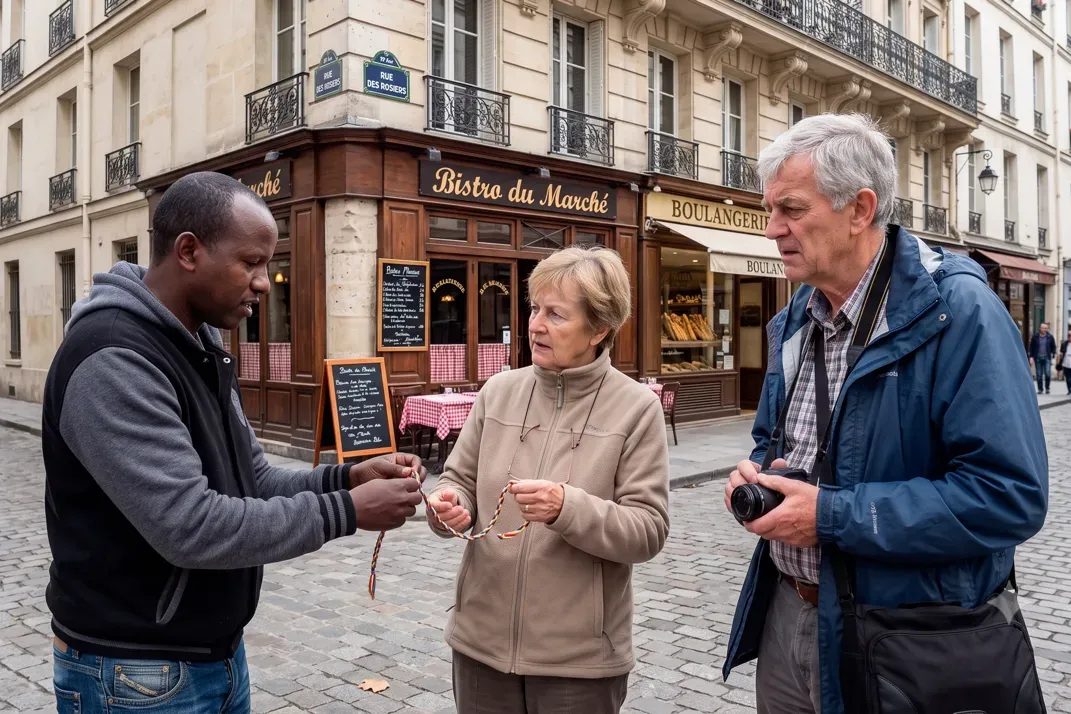
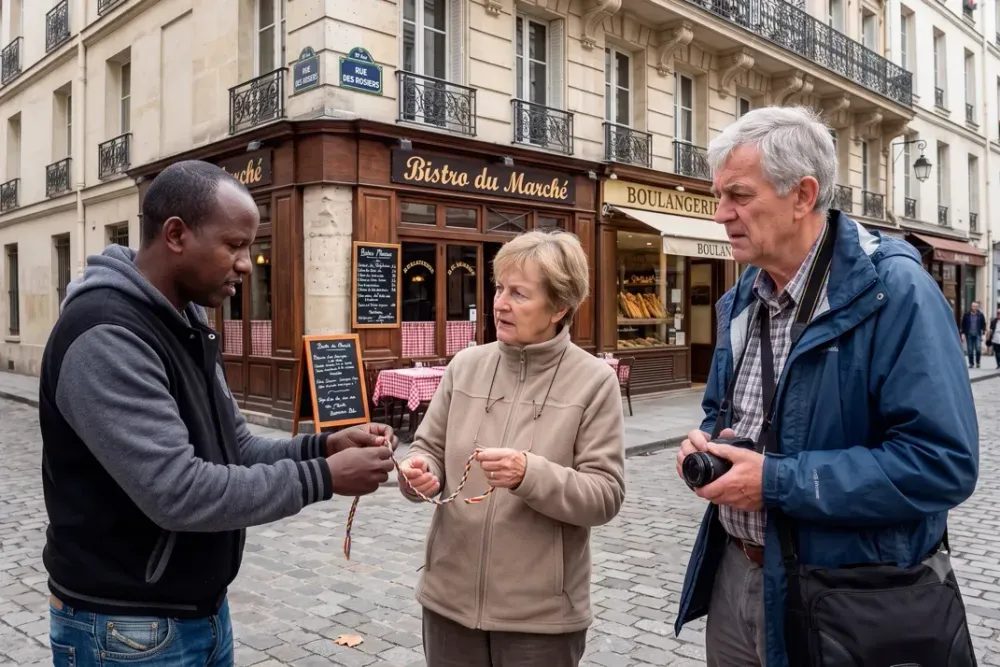
Petition and bracelet scams are the classic ambush. Someone approaches with a clipboard or a bracelet they insist on tying to your wrist 'as a gift,' then demands payment. The petition is for nothing, the bracelet was never free. In Paris, this targets tourists near major sites. In Barcelona and Rome, variations appear near popular attractions. The response is simply to keep walking. Do not make eye contact, do not extend your wrist. A person who reaches for your hand is already counting on your hesitation. This is pure distraction—the actual theft or overcharge happens while you're deciding whether to be rude. In some spots, the bracelet comes with a hard tug that lets an accomplice pick your pocket. The clipboards are often stacked with fake signatures from 'charities' that don't exist. A tourist who pauses to explain is already caught. The best move is a steady pace and a closed hand.
The Restaurant Without a Price
Overcharging in unlicensed restaurants is a low-tech scam that survives because tourists are embarrassed to make a scene. A restaurant without a menu with prices displayed, or one where prices are quoted verbally before being significantly higher on the bill, is targeting tourists. Always ask to see a menu with prices before ordering. Always check that the bill matches what was ordered and what you were quoted. In some cities, the menu shown at the table has no prices, but the one taped to the wall does. The defense is to ask twice—once for the menu, once for the bill. If the price jumps after you question it, the 'mistake' is the scam. In tourist zones, the same dish can be listed as 'market price' with no number. The waiter's response to a query is often a shrug and a new total. A printed receipt is your only paper trail.