SeychellesLuxury TravelIndian Ocean ResortsIsland HoppingCheval BlancCultural Travel
The Light That Lured Barbieri
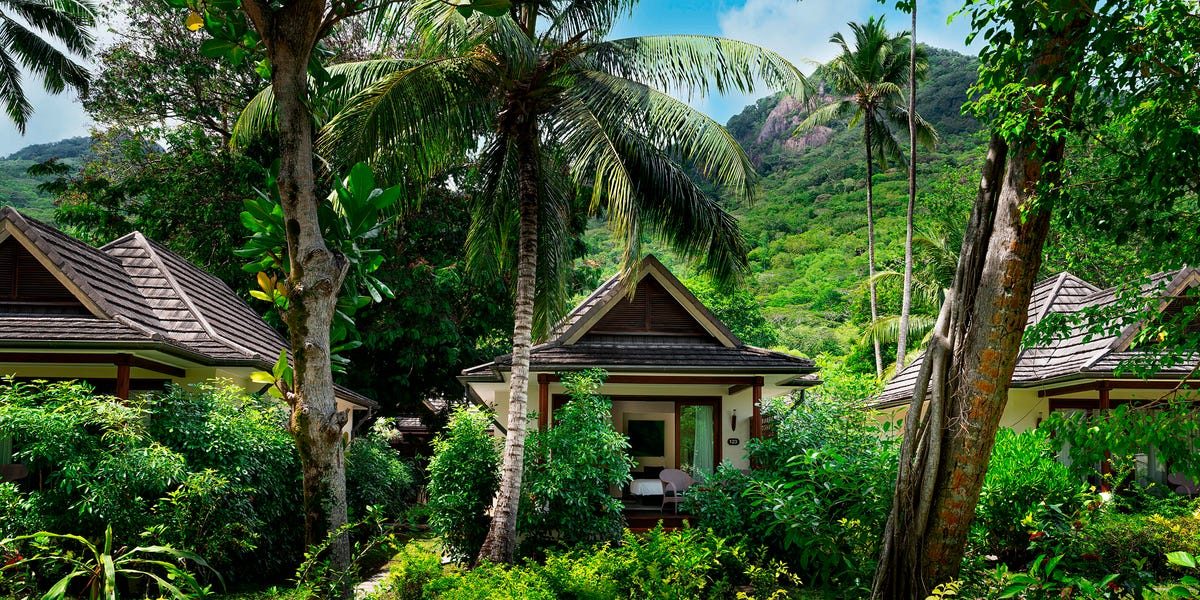
The light at Mango House arrives from every direction at once. It bounces off Anse aux Poules Bleues Bay, filters through palm fronds, and washes over the whitewashed walls of a property that once belonged to Gian Paolo Barbieri. The Italian fashion photographer—the visionary behind campaigns for Vivienne Westwood, Gianni Versace, and Giorgio Armani—first landed in the Seychelles on assignment in 1976, the year of the nation's independence. Within what seemed like a season, George Harrison and Peter Sellers bought property nearby. Barbieri stayed at Mango House on Mahé until 2014, when the house was sold and folded into Hilton's LXR Hotels & Resorts collection. The jungle-covered cliff and the bay below have hardly changed; the hotel still feels like a private home, which is exactly what it used to be. Barbieri's eye made the islands glamorous, but the light did the rest.
The Luxury Land Rush
The Seychelles is now a magnet for names that measure their ambition in square footage and opening dates. Cheval Blanc, owned by LVMH, arrived on Mahé's southern end in 2024. The Waldorf Astoria now occupies the private Platte Island. On Silhouette Island, the ecoadventure resort Niva Labriz reopened this year after a renovation. This fall, Michel Reybier brings La Réserve to Praslin. Fregate Island—one of the originals that put private-island resorts on the map—is reopening after a total transformation, with just 14 villas and three estates, plus a working farm, an art gallery, and a marina. Mandarin Oriental plans to follow in 2030. These are bold statements, but they echo a precedent: North Island, where the Prince and Princess of Wales honeymooned in 2011, showed how a single property can define a destination. Now the pipeline is so full that the marquee names are competing for coastline.
Tortoises, Coco de Mer, and a Morning Market
Beyond the resort gates, the Seychelles still runs on its own quiet logic. The nation—115 islands in the Indian Ocean, the smallest country in Africa—sits roughly 1,000 miles east of mainland Tanzania. Nearly half its landmass is protected. Aldabra giant tortoises roam free. The coco de mer, native to these islands, is the largest seed in the plant kingdom and turns up in perfumes. In Victoria, the low-key capital, the market sells vanilla pods, cinnamon bark, and fresh mangoes alongside the morning's catch, grilled over open flame and finished with piman sauce. Seychellois photographer and New York–based artist Natasha Leonie Moustache puts it plainly: “There are incredible artists working in the Seychelles; there's history, food, and community. The culture is what makes them special.” Children play soccer in the streets; families walk the beach at sunset as a five-star resort prepares to open just down the shore.
The Mahé Base
Mahé, the largest island, is the practical anchor for first-timers. Most visitors dedicate a few nights to each area, hopping on seaplanes that shuttle between Mahé and the outlying islands. The standard itinerary pairs a private-island splurge with a Mahé stay, where you can walk to museums, meet local artisans, and still reach an uninhabited island for a midday snorkel. The rhythm is deliberately split: one morning spent face-down in a coral garden, another spent tracing Creole history in a gallery. The seaplane windows frame the archipelago's granite peaks and turquoise shallows, but the real contrast is cultural. On Mahé, the resorts are woven into villages and working neighborhoods; on the outer islands, you are alone with the wind. That combination—solitude on one day, community the next—is why the Seychelles feels less like a single destination and more like a set of distinct worlds you can toggle between. The light stays constant, but the context changes with every hop.