New MexicoBadlandsHoodoosPaleontologyHikingNavajo Nation
The 45,000-Acre Badlands That Make Mars Look Ordinary
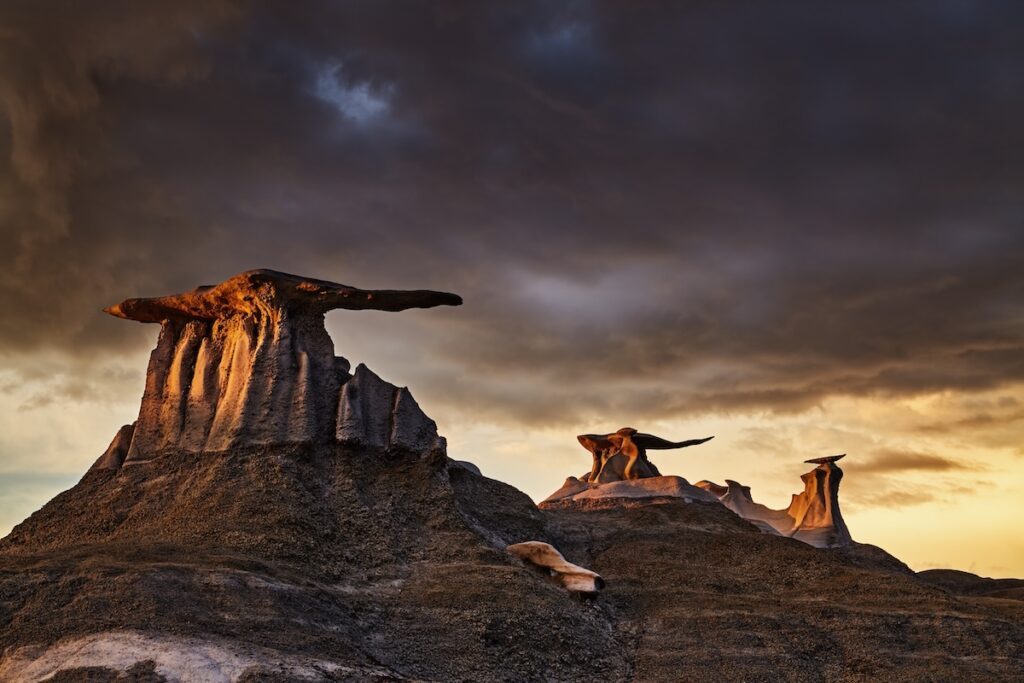
The Bisti/De-Na-Zin Wilderness sprawls across 45,000 acres of northwestern New Mexico, a dual wilderness area carved into Navajo Nation land. Erosion over millions of years has twisted ancient sediments into muted grays, browns, and rusty reds—clay hills that ripple into labyrinths. There are no marked trails, no visitor centers, just open terrain where wind and rare rainstorms keep reshaping everything. To navigate here, you must depend on your own sense of direction and a GPS, as no established paths exist to guide you. The landscape is a maze of hoodoos—skinny necks balancing wide capstones that seem to defy gravity. That combination of scale and emptiness is why photographers and explorers call it otherworldly. One ridge gives way to another, each revealing formations that seem sculpted by a different hand. The silence is broken only by wind whistling through the badlands, and the only footprints you’ll find are your own.
Navigation Here Means Your Own Judgment and a GPS
Once you leave your car at the Bisti/De-Na-Zin, every standard park amenity disappears. No signs point the way, no rangers staff a kiosk, no water taps appear at a trailhead. The Wilderness Act designates this land for self-reliance, so you navigate by sight, compass, or a GPS that knows your route. The terrain is open but disorienting—eroded clay hills and shallow arroyos all look similar from a distance. Getting lost is a genuine risk; a single wrong turn into a coupled badlands maze can cost hours. While you wander, you’re stepping on sediment that once was a coastal plain, but nothing here guides you toward the notable hoodoos or fossil beds. The only way to find them is to plan your path ahead and check your position against the skyline. This wilderness does not forgive inattention.
Hoodoos That Defy Gravity and Good Sense
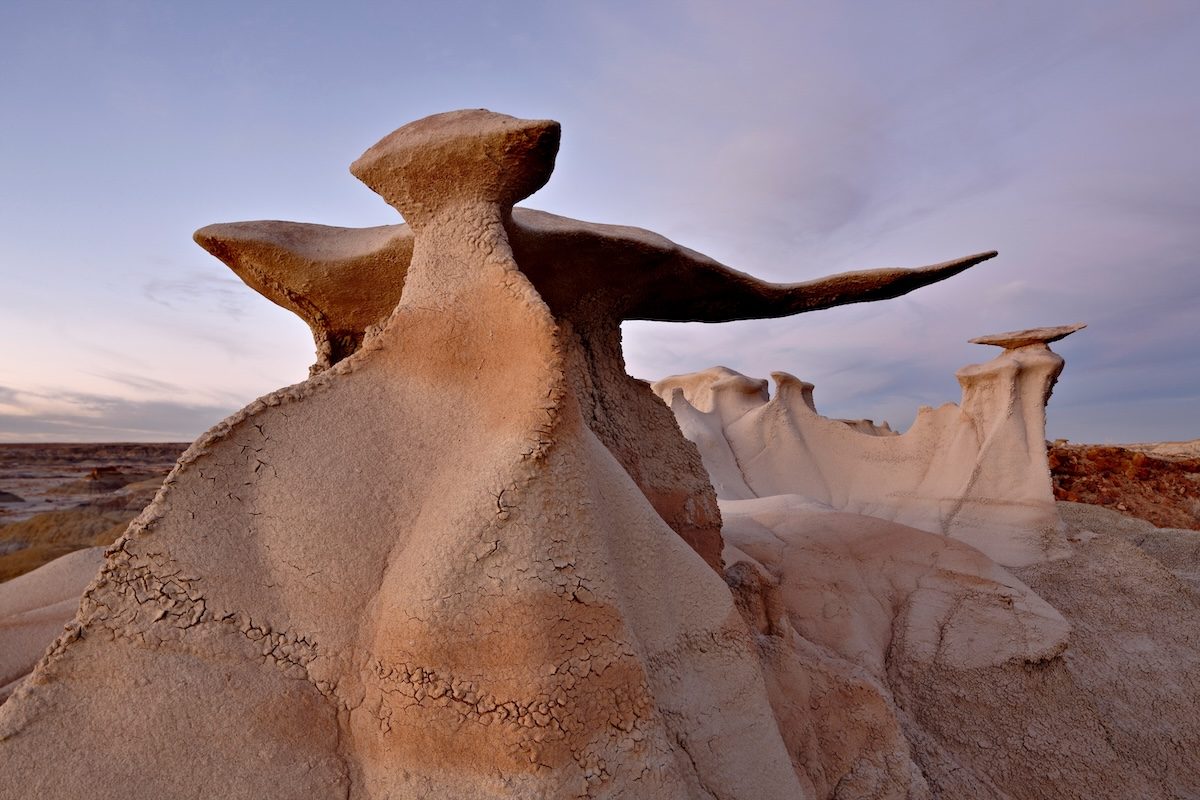
The most photographed features in the Bisti/De-Na-Zin are its hoodoos—skinny necks of mudstone capped by wider, darker stones that appear balanced by pure chance. These formations rise from the desert floor like accidental sculpture, each with its own odd silhouette and palette. The clay badlands around them carry layers of sediment: rust, ochre, gray, and brown, where erosion has sliced into hillsides to expose millions of years of deposition. Because the capstones protect the softer stone below, wind and rain carve the necks at different rates, leaving these precarious-looking columns. Some hoodoos reach several feet tall, others barely break the surface. A late-day shadow can throw a hoodoo’s outline across a mudstone slope, adding a second, temporary sculpture to the scene. For geologists, these formations are a live demonstration of differential erosion—no museum case needed.
A 70-Million-Year-Old Fossil Bounty Under Your Boots
Beneath the badlands lies a record of the Late Cretaceous, about 70 million years ago, when this region was a swampy coastal plain. Layers of exposed sediment hold fossilized remains of dinosaurs, early mammals, and prehistoric plants that thrived in those lowlands. Wind and rare rainstorms continually erode the clay hills, gradually exposing new fragments that have lain buried for tens of millions of years. Paleontologists keep finding significant fossils here, confirming the site's scientific value. Because the terrain is unmanaged, you can walk directly over these very ancient deposits, examining the stratified layers as you move across. That accessibility, combined with the sheer age of the remains, makes the area a draw for natural-history enthusiasts and fossil geeks alike.
Why Photographers Time Their Visit to First Light
The Bisti/De-Na-Zin’s subtle earth tones come alive twice a day, and the photographers who make the trek know it. Early morning, when the sun hangs low, throws long shadows across the hoodoos and badland slopes, picking out every ridge, bump, and texture. Late afternoon offers the same effect—low-angle light turns the mudstone into a mosaic of gold, ochre, and gray. The midday sun flattens the palette, washing out the relief that gives these formations their drama. For the best images, plan to be on the badlands before sunrise or in the last two hours before sunset. The trade-off is the long drive to this remote corner of New Mexico, but it’s the only way to see the wilderness as its sculptors intended—by the light that reveals them.
On Navajo Land, With the Silence to Prove It
The Bisti/De-Na-Zin sits entirely within Navajo Nation land, a fact that shapes every aspect of a visit. As a dual wilderness area, it is part of the National Wilderness Preservation System, but the land itself remains Navajo territory. There are no marked trails or visitor centers, so navigation is entirely up to you. You'll need basic map-reading skills and a GPS, because the badlands offer few natural landmarks. Once you leave your car, it's just you and the landscape—no established paths, so you can wander freely among the hoodoos and eroded formations. But that freedom demands constant attention: getting lost is surprisingly easy. The isolation creates a backcountry experience that feels like another planet compared to developed parks, and self-sufficiency is non-negotiable.
The Wind That Carves and Whistles Through the Badlands
The wind in the Bisti/De-Na-Zin is not a background effect; it’s a sculptor and a soundtrack. Over millions of years, prevailing winds have helped erode the soft mudstone and clay, complementing the rare rains that occasionally sweep across the desert. When you stand among the hoodoos, you can hear the wind funnel through the narrow gaps between formations, producing a low whistle or a sharp hiss depending on the angle. That sound creates the unearthly atmosphere that makes this place feel like a different planet. The wind also lifts fine dust, so a gust can blur the horizon for seconds. Photographers learn to shield their lenses; hikers learn to lean into it. It’s the one constant presence in a wilderness where otherwise nothing stays the same for long.