Lake NakuruSafari PlanningClimate ChangeKenya TravelBirdwatchingRift Valley
The Vanishing Spectacle
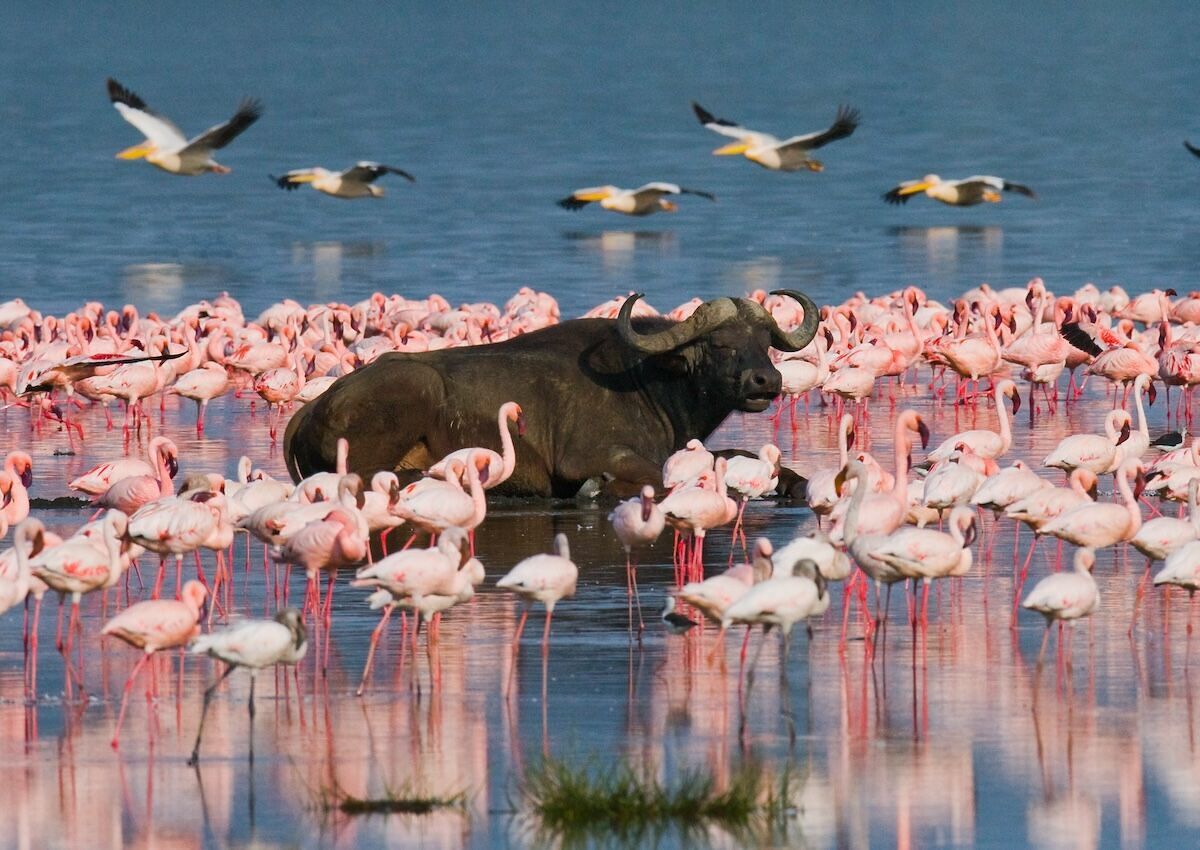
For decades, the defining image of Lake Nakuru was a shoreline that moved—a dense, living mass of pink so thick it obscured the water. That reliable wall-to-wall spectacle is now a memory. Satellite data spanning two decades show that between 2009 and 2022, the lake's surface area grew by 91 percent, while the specialized algae the birds feed on likely dropped by about half. The cause is dilution—rising water has shifted the lake's chemistry from extremely alkaline toward neutral, killing off the spirulina that lesser flamingos depend on. The birds haven't disappeared; they've relocated, often to Lake Bogoria or Lake Elementaita, and sometimes across the border to Lake Natron in Tanzania, their main breeding site.
Why the Water Is Rising
The flood of water filling Nakuru's basin comes from two converging forces. Senior warden Edward Karanja told a 2022 conference that rising water "has altered the flamingo habitat which has lead to reduced number of flamingos in the lake." The rising levels are tied to climate change: a warmer atmosphere holds more water vapor, so when rain falls, it falls harder and in greater volume. The second cause is human development on the high ground near the lake, particularly around the Mau forest complex. When forests are cleared, rainfall runs off the bare ground straight into the lake instead of being absorbed, held, and released slowly by vegetation and soil. Those twin pressures have diluted the lake's water, lowering its pH and killing the specialized algae that flamingos feed on.
Planning a Trip Around an Uncertain Bird
A visit to Lake Nakuru still deserves a top spot on a safari itinerary, but the reasoning has changed. The park, Kenya's first rhino sanctuary since the 1980s, protects both black and white rhinos, Rothschild's giraffe, lions, leopards, and several hundred bird species across 73 square miles. For flamingo-viewing, timing is now critical. The best chance to see large flocks runs roughly January through March, when numbers peak; July through October brings more moderate numbers but drier conditions and cleaner light. Autumn and spring rains can actually work against you, as fresh water further dilutes the lake and pushes the birds out. The flamingos move as a flock rather than individually—so when Nakuru is empty, Bogoria or Elementaita is often full, making a multi-lake Rift Valley loop the smartest strategy.
The Logistics: Fees, Driving, and Where to Stay
Lake Nakuru sits about 100 miles northwest of Nairobi—a two-to-three-hour drive via the Nairobi–Nakuru highway—making it one of the few parks reachable in a day from the capital without flying. Entry fees are $90 per person for non-residents, roughly $50 for children, good for 24 hours. Payment cannot be made at the gate; you must pay online through the KWS eCitizen portal before arrival, and you'll need a downloadable e-ticket, so arrange a solid WiFi connection at your lodge. Self-driving is feasible, as the park's roads are well-maintained and routes around the lake clearly marked. Accommodation inside the park ranges from Sarova Lion Hill—the most luxurious, on the lake's edge—to Lake Nakuru Lodge and Sopa Lodge as mid-range options, with Flamingo Hill Camp as a tented alternative. Packages including game drives can run from the low $100s to $300-plus per night, while budget travelers should look at guesthouses in the town of Nakuru just outside the park gate.
The Temporary Nature of Refuge
The flamingos' flight to Bogoria, Elementaita, and Natron may only be buying time. Byrne told *Africa Geographic* that "flamingo numbers are declining at the historically important feeding lakes Bogoria and Nakuru," noting that local monitoring has recorded lesser flamingo numbers at Nakuru falling from hundreds of thousands in earlier years to only thousands during periods of high water. Those alternative lakes face the same pressures—rising water levels, shifting pH, and human development along their watersheds. Byrne advises that "more regular and widespread counts are required" to understand the full picture; there is no live tracker that tells you where the flocks are this week. The research is ongoing, and the bird's distribution could shift year to year.